
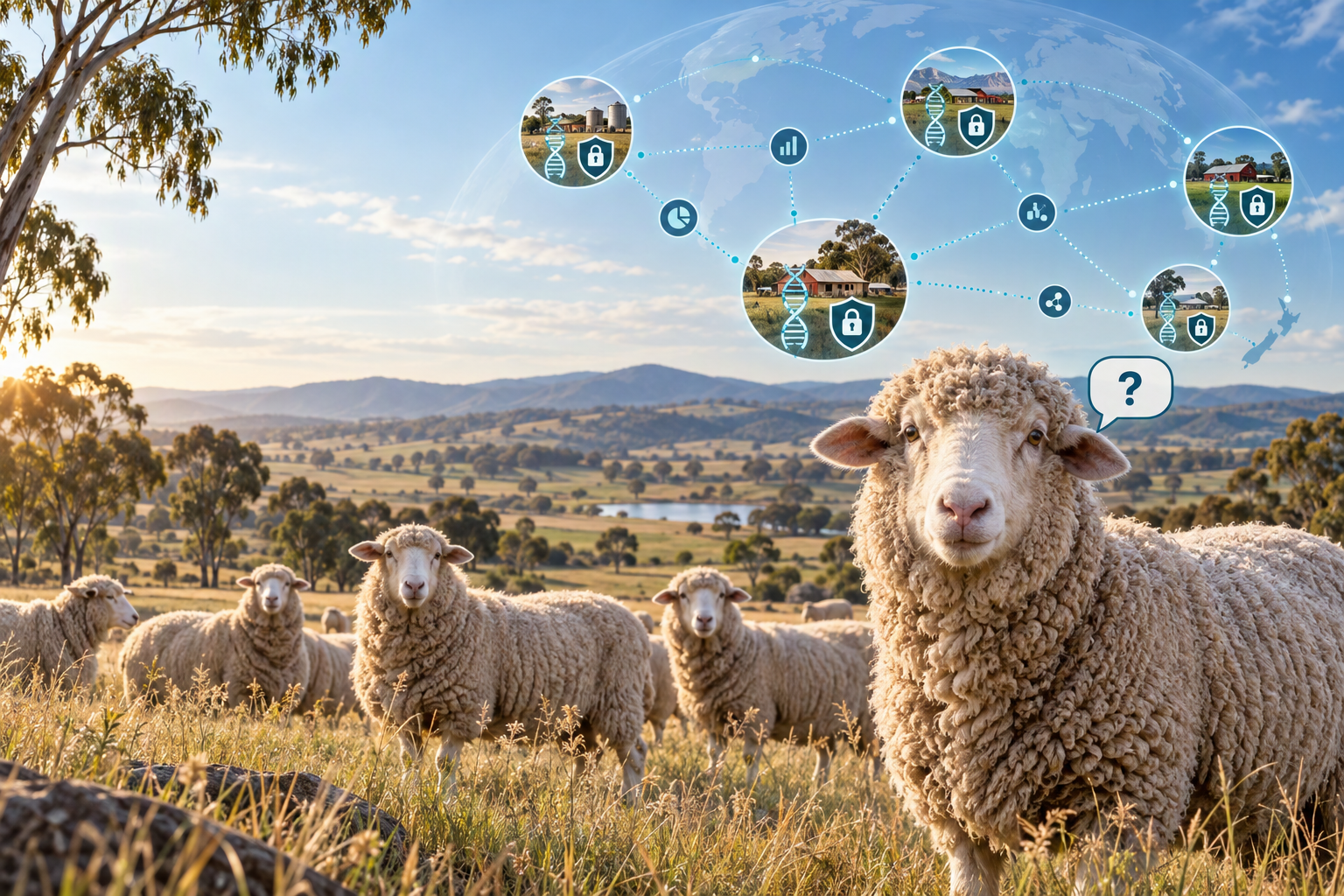
Comparing flocks without sharing data?
Imagine being able to compare your sheep flock with flocks throughout Australia and the world without ever having to release your commercial data. Federated data sharing provides a path toward this reality, providing the opportunity to develop more accurate genomic prediction models, enabling producers to make better-informed business decisions. Simply put, data federation means that the question travels to your data and only the answer comes back, without your data being copied.
CSIRO developed Serverless Beacon (sBeacon), published in Nature Biotechnology [1], for sharing and querying genomic and medical data. Built on the Global Alliance for Genomics and Health (GA4GH) Beacon protocol, the most widely used genomic data exchange standard, it provides a safe, privacy-preserving way to query human genomic and phenotypic data.
In 2025 we made the Beacon protocol ready for agentic use with AskBeacon, published in Bioinformatics [2]. AskBeacon enables the Beacon Network to be queried using using natural language. While insights from the data can be gained by simply asking a question, the data itself is protected from AI-agents through the Beacon protocol.
Students from the University of New South Wales, working with CSIRO researchers, adapted sBeacon to query data formats typical of sheep breeding, specifically Illumina® genotype text files. The result is AskTheSheep, a cloud-based tool that lets users ask questions of their data in plain language, lowering the barrier to making complex queries.
Value Proposition
Easy Integration
- Minimal manual pre-processing: AskTheSheep is built on top of sBeacon and so can directly consume variant information stored in Illumina genotype text files, reducing the need for tedious pre-processing.
- Simple infrastructure deployment: AskTheSheep is designed to be quickly deployed and low-cost to maintain, with its infrastructure defined entirely as code using Terraform.
What it offers
- Data and AI separation: AskTheSheep applies the same guardrails as AskBeacon, our earlier plain-language query tool for genomic data, ensuring the AI cannot directly access the stored genotypic or phenotypic data.
- Federated data: Like sBeacon, AskTheSheep follows the Beacon v2 standard, so each data owner keeps their raw data and only query results or aggregates are returned.
- Combined metadata and variant queries: AskTheSheep is capable of querying metadata and variant data simultaneously.
Why this matters
Sheep and other agricultural species are a major part of economies around the world and play an important role in ensuring global food security. Prediction models improve with richer datasets, but breeding data is commercially sensitive and rarely leaves the organisation that owns it. Data federation presents the opportunity to use larger datasets without producers giving up control of their own data, and better prediction models mean better-informed decisions.
Looking ahead
As breeding techniques improve and genotyping costs continue to decrease, the amount of genotypic data being generated for agricultural species will only increase. Couple this with developments in high-throughput phenotyping technologies, and there is a clear case for the community to start adopting scalable, cloud-based solutions. With this work, we have laid the groundwork for making agricultural data queryable in plain language. The lessons from AskTheSheep are already shaping our next steps: extending this approach beyond livestock genomics, so that researchers and industry across many fields can ask questions of their own data.
[1] Wickramarachchi A*, Hosking B*, Jain Y*, Grimes J, O'Brien M, Wright T, Burgess MA, Lin VSK, Reisinger F, Hofmann O, Michael Lawley M, Wilson LOW, Twine NA & Bauer DC, "Scalable genomic data exchange and analytics with sBeacon". Nature Biotechnology 2023. | DOI: 10.1038/s41587-023-01972-9
[2] Anuradha Wickramarachchi, Meg McDonald, Denis Bauer, Keith R. Hayes, Geoffrey R. Hosack, Laurence O.W. Wilson, Bioinformatic assessment of the potential for harm to humans via horizontal gene transfer from the planned release of genetically modified mosquito vectors, Journal of Biosafety and Biosecurity, Volume 8, Issue 2, June 2026, Pages 82-90, 10.1016/j.jobb.2026.04.001 .
