
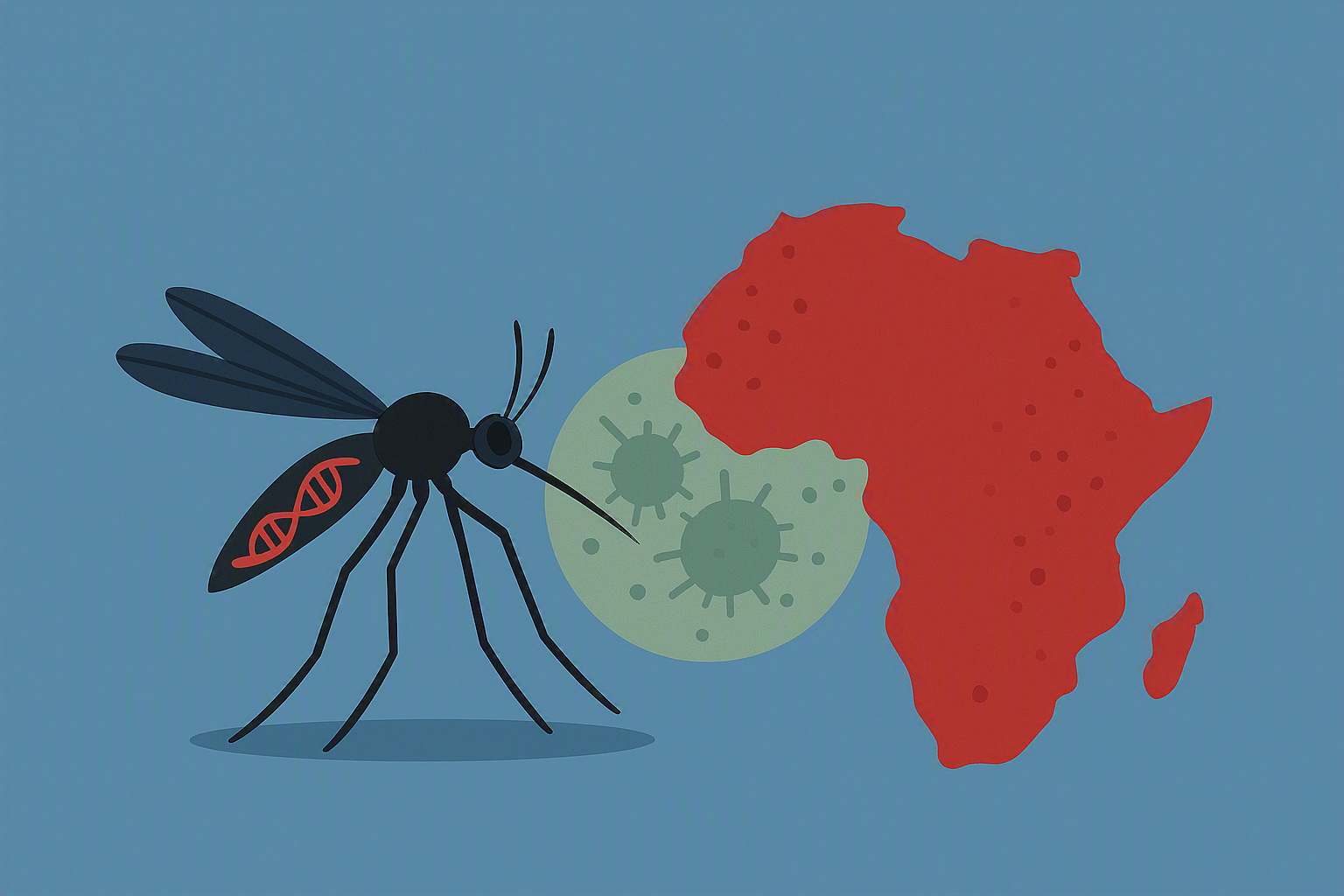
Imagine a future where malaria—one of the world’s deadliest diseases—is no longer controlled solely with medicine or nets, but through precision genetic tools that reshape mosquito populations to stop disease at its source. Genetic biocontrol represents a powerful new frontier in public health – offering the potential to dramatically reduce the burden of mosquito-borne diseases world-wide.
Advances in genetic engineering are bringing this possibility closer to reality, offering new tools to limit the ability of mosquitoes to transmit pathogens. To help realise this promise safely and effectively, researchers are working to better understand how these technologies behave in real-world environments. CSIRO has led a study examining one of the more technically challenging questions: whether genetic elements introduced into mosquitos could move across species boundaries. Recently published in the Journal of Biosecurity and Biosafety, our study provides new insights into this important aspect of genetic biocontrol.
Can genes “jump” to humans?
The scientific term for genes moving between species that can’t normally reproduce is horizontal gene transfer (HGT). It’s common in bacteria which have dedicated pathways to facilitate HGT, but very unlikely between complex organisms like humans and insects.
Still, understanding all risks involved means studying even vanishingly small risks: could DNA from these modified mosquitoes end up in human cells?
Testing this experimentally is not possible, so to answer this our researchers took a deep dive into the genomes of both humans and mosquitoes using advanced bioinformatics tools to look if there was any historical evidence of HGT between mosquitoes and humans. Spoiler alert: the study's findings are reassuring.
What the science says
Researchers searched extensively for any historical evidence that genes have moved between mosquitoes and humans over evolutionary time. If such transfers had occurred in the past, they would leave detectable traces in our DNA.
But they didn’t find any.
Out of thousands of shared DNA sequences, every match could be explained by normal evolutionary processes—shared ancestry, common biological functions, or repetitive DNA patterns. None showed signs of having “jumped” between species.
This suggests that gene transfer between mosquitoes and humans has likely never happened in all the 300,000 of human evolution and the countless bites that must have happened in that time.
What about the modified gene itself?
Given that a transfer is hypothetically possible, the team explored whether the specific genetic modification could function in humans.
For a gene to have any effect, it must:
1. Integrate into human DNA, and
2. Be switched on (transcribed) by human cellular machinery
The analysis found no evidence that the mosquito gene contains the elements needed to integrate into human DNA. It also lacks the signals allowing human cells to read and activate it.
In simple terms: even in the unlikely scenario that the gene ended up next to human DNA, it wouldn’t be expected to do anything.
Why this matters
Genetic biocontrol is a rapidly developing field, and public trust depends on rigorous, transparent science. Studies like this help build confidence by systematically testing even highly unlikely risks.
The takeaway? Based on current evidence, the risk of harmful gene transfer from these modified mosquitoes to humans is next to impossible.
Looking ahead
As technologies like gene drives and genetic biocontrol move closer to real-world use, bioinformatics will play an increasingly important role. By analysing vast genomic datasets, researchers can anticipate risks long before field deployment.
It’s a reminder that solving global health challenges—like malaria—requires not just innovation, but careful, evidence-based evaluation every step of the way.
Curious about how these approaches fit into broader digital and One Health strategies? There’s more to explore on our blog about the intersection of biology, data, and global health innovation.
Subscribe to Digital OneHealth
Stay up-to-date with our progress
